
When one considers how dynamic the forces are which keep far too many people (in lower and middle income countries as they are now called) in conditions of absolute poverty, it remains something of a mystery why so many NGOs base their approach to ‘strategy’ on activities which are calendar driven (punctually, every 3-5 years), complete with exercises which do little other than to support the status quo (Vision and Mission are rarely open to debate in any meaningful sense of the word) and ring fence favoured projects. There is a growing body of literature which suggests that the organisation-wide strategic planning exercises achieve little apart from vast waste as regards to workshops and per diems. Instead, an increasing number of agencies are starting to engage with more rigorous strategic planning tools, such as the approach of leading strategist, Richard Rumelt who states that the ‘hard work’ of strategy is always the same – ‘despite the roar of voices equating strategy with ambition, leadership, vision, mission, or long term planning, strategy is none of these. Rather, it is coherent action backed by an argument. And the core of the strategist’s work is always the same: discover the crucial factors in a situation and design a way to coordinate and focus actions to deal with them’. How many NGOs (and their so-called beneficiaries) would be better off following Rumelt’s approach?
Sustainable Development Targets – Old Wine in New Bottles?
As most people are aware, the Millennium Development Goals are soon to be ‘replaced’ (evolved into?) by Sustainable Development Targets (http://unsdsn.org/resources/goals-and-targets/). While ‘targets’ are often to be applauded and, indeed, MDGs seem to have been effective on a number of levels, many development agencies, such as Gede, are currently engaged in the debate which is aimed at ensuring that SDTs avoid some of the more obvious pitfalls which MDGs fell into. Perhaps the biggest issue which agencies agree on is the objective that SDTs should not encourage a ‘silo’ mentality towards health issues and the subsequent funding of such. Certainly, if one considers the MDGs, it’s easy to see how funding streams in particular became fixated on ‘X’ or ‘Y’ (HIV seemed to be an understandable donor focus, although this now seems to be on the wane), often at the exclusion of the very factors which made them so devastating to the lives of so many. The sad fact is that for many people living in poverty, the challenges they face cut across absolutely everything they do – and to select one or two only to address misses the point in terms of what puts them – and keeps them – in conditions of great poverty.
OVCs and Mental Health
One of the great strengths of many programmes aimed at delivering care and support to orphans and vulnerable children (OVC) is the way in which they package ‘physical’ with psychosocial support. One of the great weaknesses, however, is the way in which they package ‘physical’ with psychosocial support. By this, I mean that it is admirable that programmes at least recognise that the mental health of OVCs is important, but recent research in Ghana (http://theses.gla.ac.uk/3629/) suggests that rather generic psychosocial support (provided by most programmes) might very well ‘miss the point’ as far as the complex mental health challenges facing orphans is concerned. There is clearly a great deal to do if OVCs are to be provided with the mental health care and support they need (which, research suggests, should also include some attention on how they interact with peers) and deserve. Gede is currently reaching out to leading OVC agencies to discuss this cutting edge research and to see what can be done to support, in greater depth, the mental health needs of OVC
No Shame Day
Late last week, Gede met with renowned Nigerian Poet and media celebrity, Bassey Ikpi, to discuss plans related to the holding of a ‘No Shame Day’ in Nigeria. Bassey’s USA-based ‘No Shame Day’ (http://www.thesiweproject.org/no-shame-day/) has already been a great success and resulted in an avalanche of attention being paid not only to mental illness but also, equally important, ‘mental health’. Our initial meetings with Bassey have suggested that a possibility exists to raise awareness, across Nigeria, of the importance of a healthy mental ‘life’ which would engage a variety of people – from community based activists to celebrities from the ‘media world’ – as well as those who are perhaps yet to be convinced that ‘mental health’ is an important ‘issue’. It is always important, when addressing underserved and stigmatised health burdens to engage not only those who are ‘converted’, but also those who doubt both prevalence and impact. Watch this space as our plans develop in time for World Mental Health Day on October 10 2015
NGOs and Strategic Planning – The Groan Factor
In an era increasingly characterised by intense competition for donors funds, experienced and qualified Team members and cutting edge partnerships, it remains something of a surprise that many NGOs remain lethargic about the way in which they address and formulate ‘strategy’. In response to dynamic environments, far too many NGOs focus on calendar driven ‘strategy exercises’ which ‘tick the box’ in terms of – (i) a reaffirmation of Vision and Mission (tick), (ii) the regulation SWOT exercise (tick), and, (iii) budgeting based on spend rather than income (tick). The five year plan is then written, reaffirms the status quo (although will often pay lip service to ‘change management’ across an entire organisation) and is then filed away to be brought out of the bottom drawer in another five years. The relative marginalisation within ‘development’ which NGOs have undoubtedly experienced over the last decade is, I feel, in part due to the fact that their approach to strategy is so very poor – usually undertaken with no engagement of rigorous strategy tools such as Porter’s Five Forces, Hamel and Prahalad’s approach to core competencies, as well as Rumelt’s era defining strategy tool. Why NGOs have been so slow to evolve their approaches to strategy is something of a mystery - but their failure to do so, while retaining their faith in outdated, calendar-driven tools, will continue to result in their marginalisation within ‘development’ circles?
EXPERIENCES OF A PREVALENCE SURVEY INTERVIEWER
When we started, l was nervous because I was going to be face to face with HIV patients and was worried about their reaction but after the two weeks of training, I got to understand that they are people like us as everyone on earth. Gede Foundation /IHVN have come together as a team to strengthen the well being of people living with HIV into a further study on their alcohol use, depression and suicidality.
Quite interesting to know that most HIV patients are depressed as a result of their status and having to think that the world and everything around them is not worth living for,some tend to drink too much of alcohol to save them some mind torture while others think that killing themselves is the best way out but not withstanding, others have come in terms with it but majority needs care and attention which is part of what this Team is for.
The progress on the study is been quite interesting having to work as a team where quality training have been giving to the interviewers because they are the ones faced with administering the open ended questionnaire and also the site visit was interesting because all the sites coordinators are ready to start but few things will have to be in place before the study kicks up proper.
It's a great privilege to be part of this, first of its kind in Africa, with great tenacity from all the wonderful supervisors and my co-interviewers (the team) set to deliver and improve the quality of health for people living with HIV.
Meeting at the Embassy of the Netherlands
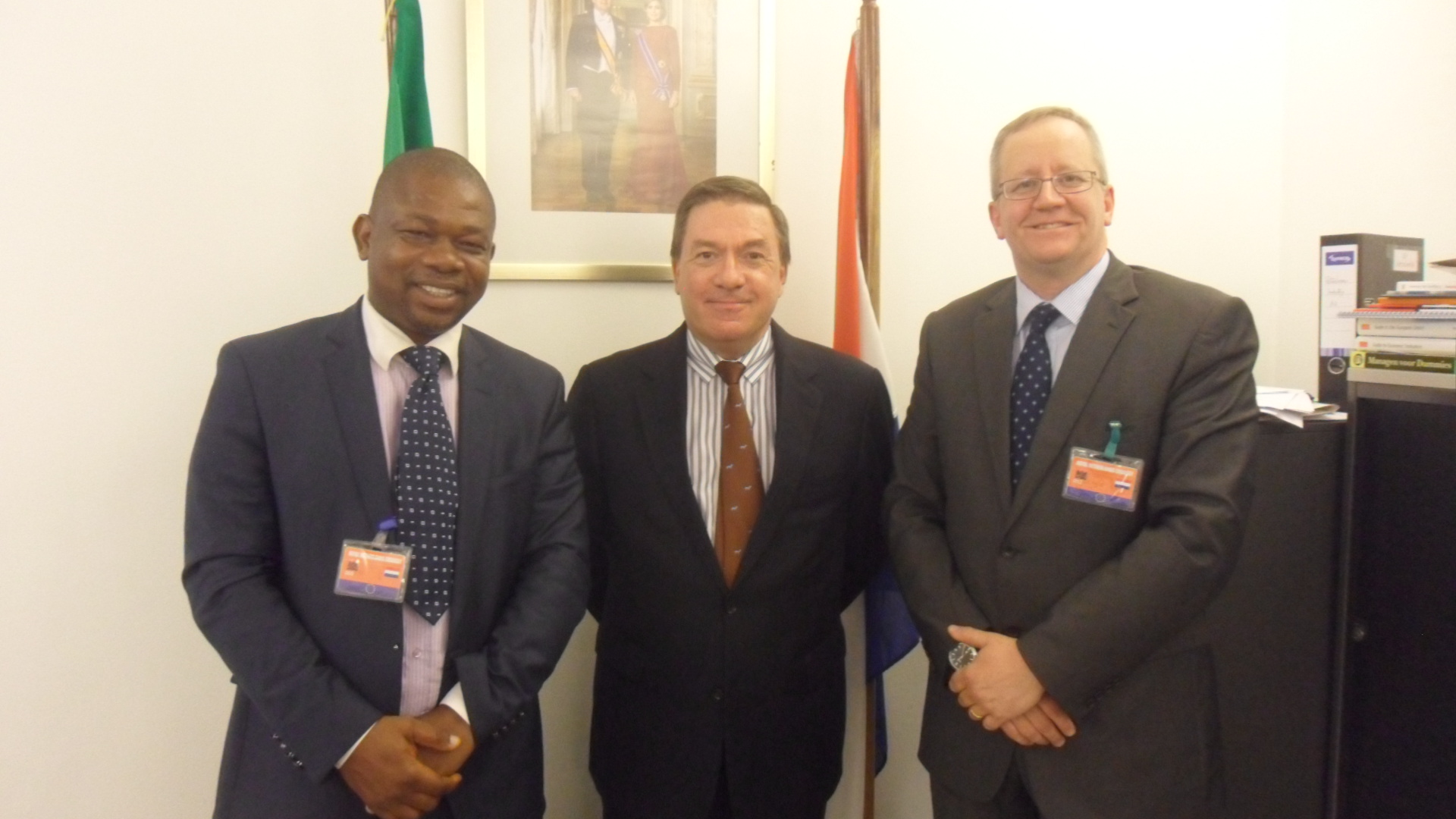
On Thursday May 21 2014, Gede’s Managing Director (John Minto) and Performance Director: Resource Mobilisation and Partnership Management (Godwin Etim) met with the Ambassador of the Kingdom of the Netherlands, His Excellency, Mr John Groffen. The meeting marked the latest stage in the Foundation’s partnership with the Embassy as Gede delivered HIV-AIDS testing and counselling services to Embassy staff over 2006-2008. During the course of the meeting, it was agreed that Gede would deliver, to Embassy staff, a session of its ‘Managing Stress in the Workplace Programme’ while the Ambassador also expressed interest in working with Gede to mark Mental Health Day on October 10 2015. The meeting also reflected on the innovative ways in which the Government of the Netherlands is currently pioneering the use of ICT to prevent and ‘treat’ a range of mental health conditions – something which the Government has used to help address the mental health treatment gap. Watch this space for further news about the partnership between the Embassy and Gede
Gede and Mental Health Awareness and Advocacy Foundation in Nigeria
On the 14th May 2015, Gede participated at the 8th Annual Stakeholders’ Council meeting of the Mental Health Awareness and Advocacy Foundation in Nigeria held in Ibadan, Oyo State. Participants, mainly members of Civil Society Organisations from the Federal Capital Territory, Abia, Benue, Delta, Kano, Kwara, Ogun and Lagos States presented reports from their various activities in promoting the objectives of the Council.
Discussions covered i) mental health leadership and Advocacy Programme ( mhLAP ) phase two- using anti-stigma campaign and WHO quality rights toolkits, ii) plan of action for coming years, and, iii) funding opportunities including the next phase of Australian Agency for International Development(AusAID) grants supporting the work of the Council.
Participants agreed to the current gaps existing in the promotion of mental health through awareness, advocacy and treatment and called for more representation of the group on the national level. Gede was invited and welcomed into the Council due to its relevance in the objectives of the group and recognised within its key role in promoting mental health through research, advocacy and policy influence. It is expected that a synergy between the council and the CSO coalition chaired by Gede in the FCT will enhance the needed collaboration supporting national response for mental health treatment and care.
Integration…The Holy Grail of the Mental Health Movement?
As readers of Gede blogs will know, one of the key objectives of the ‘mental health movement’ is to see the screening, treatment and referral of common mental disorders (mainly depression and alcohol abuse) integrated into health service delivery platforms 9including through HIV-AIDS Adherence Counsellors). Although the strategy tends to give relatively little consideration to the reasons why a mental health ‘treatment gap’ exists (and almost totally ignores options related to capacity building Facility based health workers through, for example, ICT and qualified members of the diaspora), the core focus tends to be on developing ways in which to ‘task shift’ in health systems (even though this language seems to have become the slightly more politically acceptable ‘task sharing’) – essentially looking at ways in which mental health can be integrated into the busy daily lives of health workers. This utterly admirable aim runs the risk, however, of being practically difficult to implement or even ‘sell’ to those health workers whose waiting rooms and spaces are already bulging with people who need purely biomedical treatment and care. And what is the implication on ‘time management’ when patients (‘clients’ in our modern parlance) show more problematic mental health symptoms? We all know that long marches have to start with a small step, but one of the key issues in terms of ‘task sharing’ is that the health workers themselves seem rarely to be engaged in these initiatives…
Where are NGOs headed?
One of the key strengths of NGOs is that they have, historically, offered a mid-point between Government and the private sector. In theory, they offer a pathway to ‘development’ which places a heavy and appropriate emphasis on issues such as community engagement, partnership building, transparency and accountability. If this is true, why have some recent commentators reflected on what seems to be a growing lack of trust between ‘the public’ (especially in high income settings) and NGOs themselves? Where does this come from? I have always suspected that one source comes from what is often seen as the NGO value-added – the way in which they are driven by Vision and Mission. From my own experience, NGOs of all descriptions tend to (every five years) undertake a calendar driven and largely useless ‘strategic review’ which spends several days reaffirming their Vision and Mission statements, at the end of which appears ‘the strategy’. This tends to be a relative waste of time as for most agencies, Vision and Mission are not really up for real debate. Instead, NGOs might be better engaged with the approach of strategy experts such as Richard Rumelt who appeals for ‘strategy’ to be based on a response to very specifically identified problems, challenges and/or opportunities which are identified in 'scientific' and rigorous ways which would challenge the relatively superficial analysis (often second-hand and out of date) of many NGOs. Watch this space for more about strategy in the coming weeks.