Reducing the plight of Orphans and Vulnerable Children (OVC) in Nigeria

In 2003, Gede Foundation began a journey of hope for children orphaned by HIV-AIDS in the FCT. Orphans and vulnerable children who were out of school were reenrolled into various schools and vocational training centers to support their households. Through working with partners, the Foundation has touched the lives of over 4,000 vulnerable children in rural communities across the country and is still exploring more avenues to support this population.

Gede focuses its project activities on ensuring that (i) school age OVCs are provided with the appropriate resources to acquire basic education, and,(ii) older OVCs are enrolled into skills acquisition classes which provide them with  sustainable skills for  income generating activities such as computer engineering, knitting, soap making, bead making ,hairdressing, tailoring, catering, laundry, metalwork and auto mechanics.

On the 17th December, 2014, 90 older orphans who succeeded in this year’s training in various communities were provided with equipment and materials to start their businesses.

Next year, Gede will also work with national partners to develop a programme through which the mental health needs of OVCs and their trainers and carers are also factored into future programming.

Training on WHO CIDI tools

Team members from Gede Foundation attended a 3-day training on the use of the ‘Composite International Diagnostic Interview” (CIDI) tool at WHO’s collaborating Centre for Research and Training in Mental Health at the University of Ibadan.

Training focused on three modules namely; depression, suicide and alcohol use. This training is part of the preliminary activities which Gede is undergoing to ensure that the proposed prevalence study ( in early 2015) on depression and substance abuse in the FCT  among  a sample of  1200 people living with HIV is carried out with standardized  and reliable data capturing tools.

Partnering with IHVN, the study will be carried out within an urban and semi-urban ART sites in the FCT.

The overall aim of this survey is to show the prevalence and impact of mental health conditions as a precursor to integrating the screening and treatment of common mental health disorders into HIV-AIDS care and support.

For further information about the study, you can contact Cynthia Ticao-PhD via cjticao@gedefoundation.org

ARFH 25th Anniversary

Today, Gede attended the 25th anniversary of the Association for Reproductive and Family Health (ARFH) and participated in the event’s NGO Dialogue Meeting which explored the role of NGOs in national development. ARFH (www.arfh-ng.org) was established in Nigeria in 1989 and has become a leading agency within the sphere of reproductive and family health, with a focus on service delivery as well as providing essential public health information for youths and adults. Gede pays tribute to the significant contribution ARFH has made to a wide range of health issues in Nigeria and wishes them even greater success in the next 25 years.

Gede hosting Mental Health Dialogue and NACA’s Sub Committee on Mental Health meetings

Today, Gede hosted and Chaired two important meetings – (i) a presentation by the Planned Parenthood Federation of Nigeria (as part of Gede’s Mental Health Dialogue Programme) on the Psychological Impact of Sexually Transmitted Infections, a much overlooked yet serious public health issues, most particularly in teenagers and adolescents. As with so many mental health issues, the key issues focus on stigma and awareness raising as well as the gap between the number of people needing treatment and the number of health care professionals available to provide it, and, (ii) NACA’s Technical Working Group for Care and Support Mental Health Sub-Committee which is tasked with developing a working model of integrating the screening and treatment/referral of a range of mental health conditions (yet to be defined) in HIV-AIDS care and support regimes run by Adherence Counsellors. The first meeting of the Sub-Committee reflected on a number of key issues, particularly the practicality of asking busy lay health workers to add even more activities to their already full work load. The Sub Committee is due to report back to the Technical Working Group by the end of April 2015

GEDE TO CHAIR THE NATIONAL AGENCY FOR THE CONTROL OF AIDS’ (NACA) MENTAL HEALTH SUB-COMMITTEE ON MENTAL HEALTH

The National Agency for the Control of AIDS in Nigeria reports into the Presidency and is responsible for the overall coordination of the response to HIV-AIDS.
 
At the most recent meeting of NACA’s Technical Working Group held to discuss the National Guidelines on HIV-AIDS Care and Support, participating agencies (including the Association for Reproductive and Family Health, FHI360, PEPFAR, Society for Family Health, USAID) nominated Gede to Chair the newly established Sub-Committee on Mental Health.
 
The work of the Sub-Committee, which will meet for the first time on December 3 2014, will, in part, focus on assessing ways in which mental health can be integrated into national HIV-AIDS care and support regimes. Gede’s Chairing of the Sub-Committee reflects the Foundation’s work in terms of undertaking (with partners) a peer reviewed study into the prevalence and impact of common mental disorders in a sample of people living positively in Federal Capital Territory coupled with a project which will assess ways in which the screening and treatment/referral of depression and substance abuse can be integrated into HIV-AIDS care and support.
 
Please return to the site to receive updates on the Sub-Committee’s progress.

Mental Health Dialogue-PRAWA

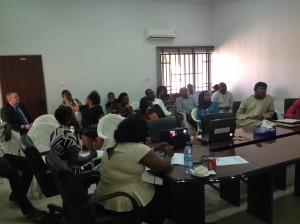
On Wednesday November 13 2014, as part of Gede’s ‘Mental Health Dialogue Programme’, PRAWA (Prisoners’ Rehabilitation and Welfare Action) delivered an insightful presentation to 18 representatives from Civil Society Organizations in Gede’s meeting room at 13 Danube Street, Maitama, Abuja.

PRAWA’s presentation focused on the innovative work they have done in terms of the treatment of prisoners, conditions of imprisonment, coupled with the training of Prison Officers on human rights and good prison practice. PRAWA’s work also covers a range of issues involving the mental health of both prisoners and those responsible for their care. For further details about Gede’s ‘Mental Health Dialogue Programme’ and to obtain the list of speakers for November 2014-March 2015, please email Solape Bamijoko.

“Getting it right-Mental Health and HIV-AIDS care and support”

Gede Foundation appeared in another edition of the widely read ‘Health Reporters’ with an article on ‘Getting it right – mental health and HIV-AIDS care and support’. The article (http://healthreporters.info/2014/10/29/getting-it-right-mental-health-and-hivaids-care-and-support/) explores the importance of ensuring that people living positively have access to appropriate care and support regimes which also include the screening of depression and substance abuse in particular. Another article, written by Gede, on the links between depression and HIV-AIDS will appear shortly.


Community-based Mental Health activities-CBM’s approach

Today, as part of the Foundation’s Mental Health Dialogue Programme, Gede hosted a talk given by Dr Emeka Nwefoh, Mental Health Advisor at CBM Nigeria (www.cbm.org). Dr Nwefoh’s presentation focused on the challenges in designing and implementing community based mental health programmes and resulted in a lively Q&A session. 19 civil society organisations attended the presentation and concluded with a strong agreement that the Dialogue Programme will develop into an important ‘calendar event’ for all organisations interested not only in mental health per se, but in underserved and stigmatised health burdens in general. The next Mental Health Dialogue Programme presentation will be delivered on November 12 2014 by Dr Uju Agomoh, Executive Director of PRAWA, who will talk about the rights of those incarcerated in prisons.

Mental Health Dialogue – Faith-Based Perspective

MH-Dialogue-Religious-perspective.jpg

Civil Society Organizations namely PPFN, CACA, NINERELA+, doctors and health personnel from the Defense Medical Center, TB Network Nigeria and PRAWA were at Gede Foundation to participate in a discussion that is centered on faith-based perspective of mental health. Key in the discussion was the perception by many people in Nigeria that persons with mental health condition are “demonic” and should undergo some spiritual deliverance sessions to exorcize the “demons” responsible for the disorder. However, the practice commonly used by some of the religious groups in relation to the management of common mental disorder and mental illness is the use of groups within the fold such as the women fellowship, youth fellowship and counseling units to offer support at that level and thereafter seek for medical treatment.

Religious leaders feel that many of their followers believe that they have powers to resolve mental health challenges. However, most leaders lack appropriate qualifications and experience to make in depth judgments relating to mental and other health issues, and simply tell their members to pray and have faith in their recovery.

Participants suggested that some religious leaders might benefit from formal training in mental health conditions which would be for the benefit of the communities they serve.

HIV/AIDS & Mental Health – Perspectives of a Medical Doctor - Part 3

To improve the quality of life of the couple, whose story was given in the previous blog, issues of mental health – alcohol abuse and psychological trauma had to be addressed. I must tell you it wasn’t easy but we have made progress. The wife has been able to overcome the fear of her husband’s outbursts and is now on antiretroviral medication while the husband is scheduled to go through with a series of psychotherapy before commencing his antiretroviral. From my experience with clients at Gede Foundation, I can say that HIV is a biopsychosocial illness. I hope my fellow colleagues would come to a quick realization of this for the better management of people living with HIV/AIDS to better improve quality of life. I look forward to your comments and reactions. Dr. Michael Ameh can be reached on mameh@gedefoundation.org